6 Minute English
medium level6 Minute English / United against food waste
Episode 221229/ 16 Dec 2022
4.7(32,037 ratings)·34,475 students
Transcript
Note: This is a transcript of a spoken conversation and is not a word-for-word script.
Note: This is not a word-for-word transcript.
Neil
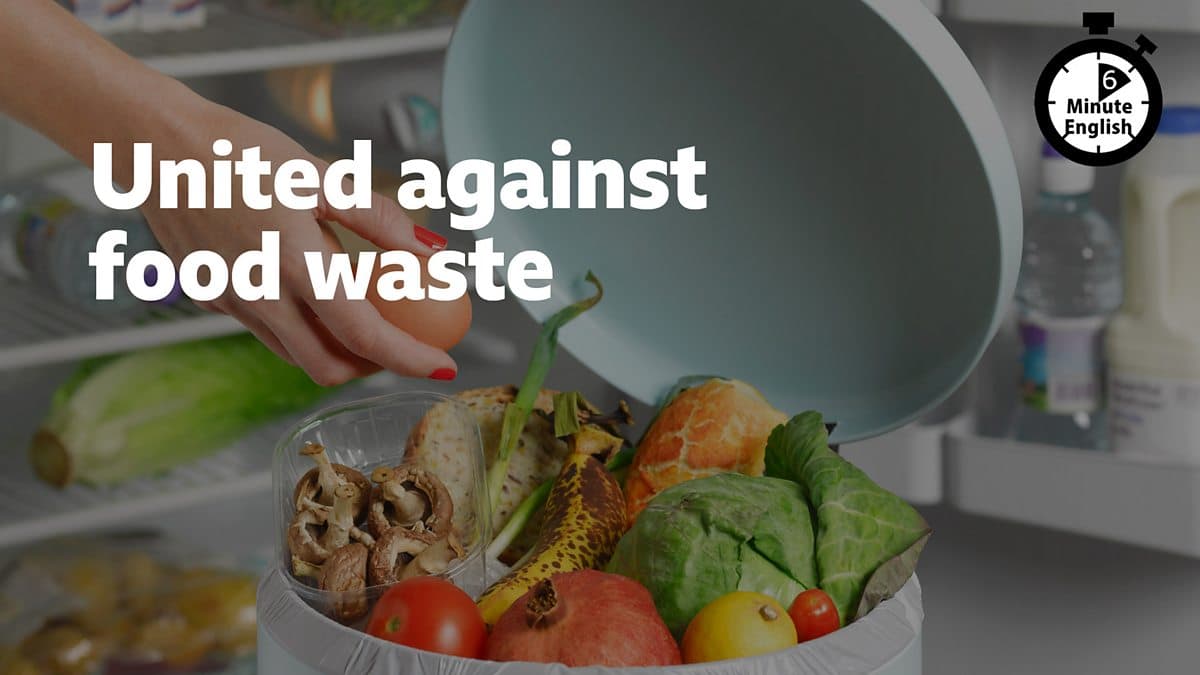
Hello. This is 6 Minute English from BBC Learning English. I'm Neil.SamAnd I'm Sam.NeilDoes this situation sound familiar to you, Sam? You reach into the kitchen refrigerator looking for something to eat, only to find a brown lettuce, a sad-looking cucumber, and some two-week old fish, all past its use-by date - the date printed on the food container showing how long it is safe to eat.SamOh, I'm guilty of wasting food, Neil - me and many others. According to the UN, one third of the food we grow ends up in the rubbish bin. And it's not just food that's wasted - it's also the resources used to produce that food, things like water, land and transport.NeilIn this programme, we'll be talking about food waste. We'll meet the people trying to stop us from throwing good food away, and, as usual, we'll be learning some new vocabulary as well.
Sam
Here in the UK, big supermarkets import food from abroad for customers to enjoy all year round. Summer fruit like strawberries and mangos are flown in from tropical countries and sold in winter, increasing carbon emissions as well as waste.
Neil
Yes, that's why you hear the phrase, 'eat local, eat seasonal' to encourage people to buy and eat food which has been grown in their local area, at that time of year. So, Sam, my question is - which of the following foods can be grown in Britain throughout the year? Is it:a) strawberries?b) kale? or,c) rhubarb?
Sam
Hmmm, it's definitely not strawberries 'cos they only grow in summer, so I'll say b) kale.
Neil
OK, I'll reveal the answer later. We've talked about supermarkets in Britain, but food waste is happening all over the world. In Puerto Rico, too, most people shop in supermarkets, making it difficult for farmers to choose what to sell, and how much to charge for their fruit and vegetables.
Sam
Josefina Arcay is a farmer who wanted to make it easier for customers to buy local food. She started an online shop to connect shoppers with farmers directly, without the supermarkets. Here Josefina explains her project to Jo Mathys, reporter for BBC World Service Programme, People Fixing The World.
Jo Mathys
So Josefina, that's the farmer who we heard earlier growing those giant avocados, she used to have to sell her crops to these kind of middlemen.
Josefina Arcay
We had a lot of I don't know how you call carreros... it's just people that have a big truck and they will just come by, and they will say, 'What do you have? Ohhh that's too expensive! Wooh very expensive! I want it half that price'. So I didn't have any way of controlling how I was going to sell - it just depended on these people coming.
Jo Mathys
And a lot of these carreros are kind of commissioned by the supermarkets. All this leads to food waste because it's really hard for farmers, like Josefina, to predict which crops they're going to be able to sell.
Now try this...
Practise your skills with more lessons from 6 Minute English.
FreeRp169,000100% off
Gratis selamanya · Akses penuh
Go to full courseThis lesson includes:
- Audio lesson
- Downloadable PDF
- Full transcript
- Full access — free forever
Takeaways
Podcast
6 Minute EnglishLatest 6 Minute English
6 Minute English / Scared of speaking English?
Episode 260122 / 22 Jan 2026
Beth and Pippa talk about why we often find speaking a new language scary.
4.8(12,708)FreeRp239,000

6 Minute English / Can AI solve crime?
Episode 250417 / 17 Apr 2025
Could artificial intelligence be used to solve a murder?
4.8(26,188)FreeRp239,000
6 Minute English / Learning multiple languages
Episode 250410 / 10 Apr 2025
Is learning languages good for you?
4.5(4,985)FreeRp209,000Bestseller
6 Minute English / Are we getting more allergic to things?
Episode 250403 / 03 Apr 2025
Do you know anyone who has 50+ allergies?
4.8(32,758)FreeRp179,000
6 Minute English / The country that measures happiness
Episode 250306 / 06 Mar 2025
Is happiness the key to success?
4.4(34,274)FreeRp219,000

6 Minute English / Becoming a musician
Episode 250130 / 30 Jan 2025
Hear about life as a professional musician
4.6(3,316)FreeRp239,000
6 Minute English / Is rejection good for us?
Episode 260917 / 17 Sep 2026
How do you feel about being rejected?
4.7(18,187)FreeRp229,000

6 Minute English / Can apps teach you a language?
Episode 260910 / 10 Sep 2026
What's better for learning languages – an app or a class?
4.2(24,752)FreeRp199,000
6 Minute English / Climate change and extreme weather
Episode 260903 / 03 Sep 2026
Every year we see damage, death and destruction caused by hurricanes, cyclones and typhoons - tropical storms. Is climate change making this impact worse?
4.4(35,884)FreeRp159,000
6 Minute English / How do we describe smells?
Episode 260827 / 27 Aug 2026
What is your favourite smell?
4.2(34,792)FreeRp119,000