6 Minute English
medium level6 Minute English / Addicted to war
Episode 230511/ 11 May 2023
4.5(2,175 ratings)·5,091 studentsBestseller
Transcript
Note: This is a transcript of a spoken conversation and is not a word-for-word script.
Note: This is not a word-for-word transcript.
Neil
Hello. This is 6 Minute English from BBC Learning English. I m Neil.
Sam
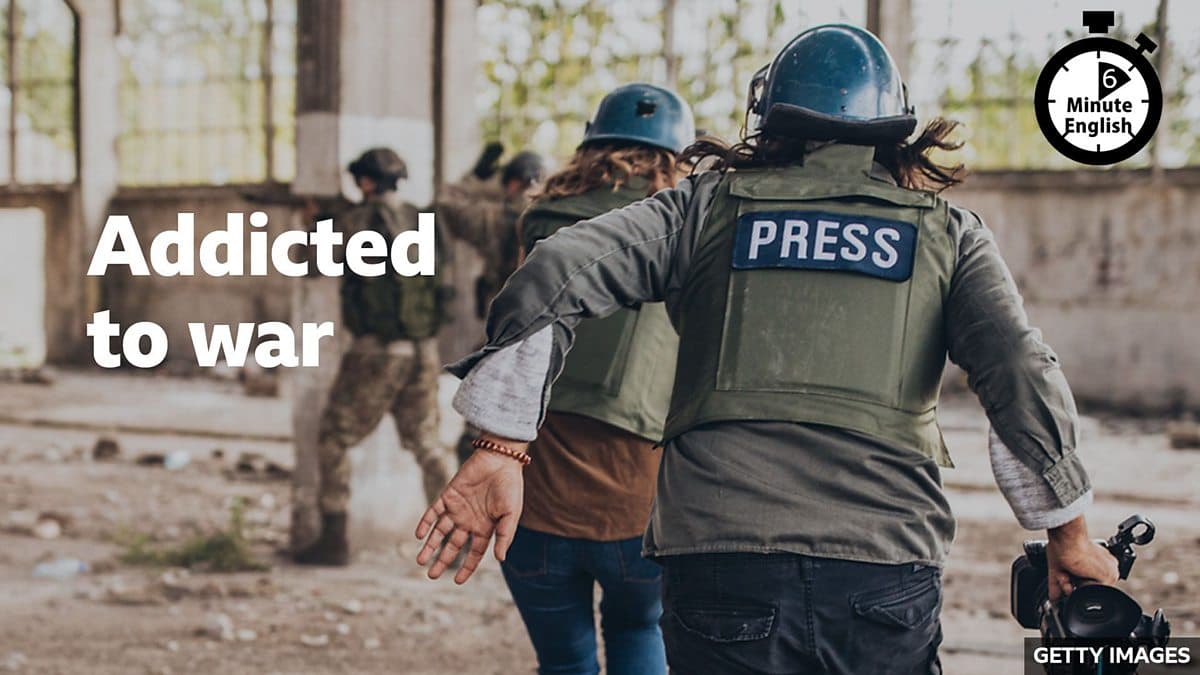
And I m Sam. In this programme, we ll be hearing about the extraordinary life of a well-known BBC journalist, Fergal Keane. As a BBC war correspondent, Fergal witnessed some of the most violent events in recent history. Fergal s reporting helped his television audiences make sense of the horrors of war, but underneath there were more personal reasons attracting him to the frontline.
Neil
Despite the danger, Fergal found himself going back again and again to report from war zones. It gave him something he couldn't get anywhere else a massive rush of adrenaline, and Fergal started to worry that he was becoming addicted to war.
Sam
In his new book, The Madness: A Memoir of War, Fear and PTSD , Fergal discusses living with PTSD, or post-traumatic stress disorder, a type of psychological suffering that results from witnessing extreme violence. We ll hear about some key events in Fergal s life, and, as usual, we ll be learning some new vocabulary as well.
Neil
But first, I have a question for you, Sam. The term, PTSD, is quite new, but descriptions of the mental suffering of war go back to ancient times. Something similar to PTSD is mentioned in Viking sagas and in stories about both World Wars. So, what was the name of the PTSD-like condition suffered by many soldiers during the First World War? Was it:a) nostalgia?b) shell shock? or,c) combat stress?
Sam
I think the answer is shell shock.
Neil
OK, Sam, I ll reveal the answer later in the programme. Fergal Keane, who was born in Ireland, had seen violence ever since the early days of his career covering the fighting in Belfast. He had already reported from wars all over the world when, in 1994, he was sent to cover the civil war in Rwanda. But what Fergal saw there shocked him like nothing before, as he told Mobeen Azhar, presenter of BBC World Service programme, Lives Less Ordinary.
Fergal Keane and I began to have nightmares of Rwanda. And of course, at that stage, you know, it was obvious that I was traumatised but, again, did I go to a psychiatrist? No, I didn't. I kept doing the job.
Mobeen Azhar
Did you turn to other things?
Now try this...
Practise your skills with more lessons from 6 Minute English.
Free
Always free · Full access
Go to full courseThis lesson includes:
- Audio lesson
- Downloadable PDF
- Full transcript
- Full access — free forever
Takeaways
Podcast
6 Minute EnglishSupport
Everything here is free and ad-free. If these lessons help your English, you can buy me a coffee to keep it running.
Buy me a coffeeLatest 6 Minute English
6 Minute English / Scared of speaking English?
Episode 260122 / 22 Jan 2026
Beth and Pippa talk about why we often find speaking a new language scary.
4.8(12,708)Free

6 Minute English / Can AI solve crime?
Episode 250417 / 17 Apr 2025
Could artificial intelligence be used to solve a murder?
4.8(26,188)Free

6 Minute English / Learning multiple languages
Episode 250410 / 10 Apr 2025
Is learning languages good for you?
4.5(4,985)FreeBestseller
6 Minute English / Are we getting more allergic to things?
Episode 250403 / 03 Apr 2025
Do you know anyone who has 50+ allergies?
4.8(32,758)Free
6 Minute English / The country that measures happiness
Episode 250306 / 06 Mar 2025
Is happiness the key to success?
4.4(34,274)Free
6 Minute English / Becoming a musician
Episode 250130 / 30 Jan 2025
Hear about life as a professional musician
4.6(3,316)Free
6 Minute English / Is rejection good for us?
Episode 260917 / 17 Sep 2026
How do you feel about being rejected?
4.7(18,187)Free

6 Minute English / Can apps teach you a language?
Episode 260910 / 10 Sep 2026
What's better for learning languages – an app or a class?
4.2(24,752)Free
6 Minute English / Climate change and extreme weather
Episode 260903 / 03 Sep 2026
Every year we see damage, death and destruction caused by hurricanes, cyclones and typhoons - tropical storms. Is climate change making this impact worse?
4.4(35,884)Free
6 Minute English / How do we describe smells?
Episode 260827 / 27 Aug 2026
What is your favourite smell?
4.2(34,792)Free